Policy Decision and Enforcement Architecture
Authorization rules often begin inside a service. As more services need the same account rights, business conditions, or relationship model, copying those rules can produce inconsistent decisions and make changes difficult to review.
A policy architecture separates evaluating access from enforcing the result. That separation can exist inside one process or across services. Moving evaluation outside the application adds policy delivery, data consistency, and availability responsibilities; it is not automatically a stronger design.
The authorization models define what access means. This topic defines where decisions run and who supplies their facts.
Assign the responsibilities
| Role | Responsibility | Claims example |
|---|---|---|
| Policy Enforcement Point (PEP) | Intercept the operation, establish trusted context, enforce the result | Payment API protects approval and its commit |
| Policy Decision Point (PDP) | Evaluate policy against relevant facts | Application evaluator, local engine, or remote service |
| Policy Information Point (PIP) | Obtain authoritative attributes or relationships | Entitlement/resource data retrieval |
| Policy Administration Point (PAP) | Govern policy/model changes and delivery | Reviewed policy repository and release process |
These are logical roles, not a requirement to deploy four services. One component may perform several roles.
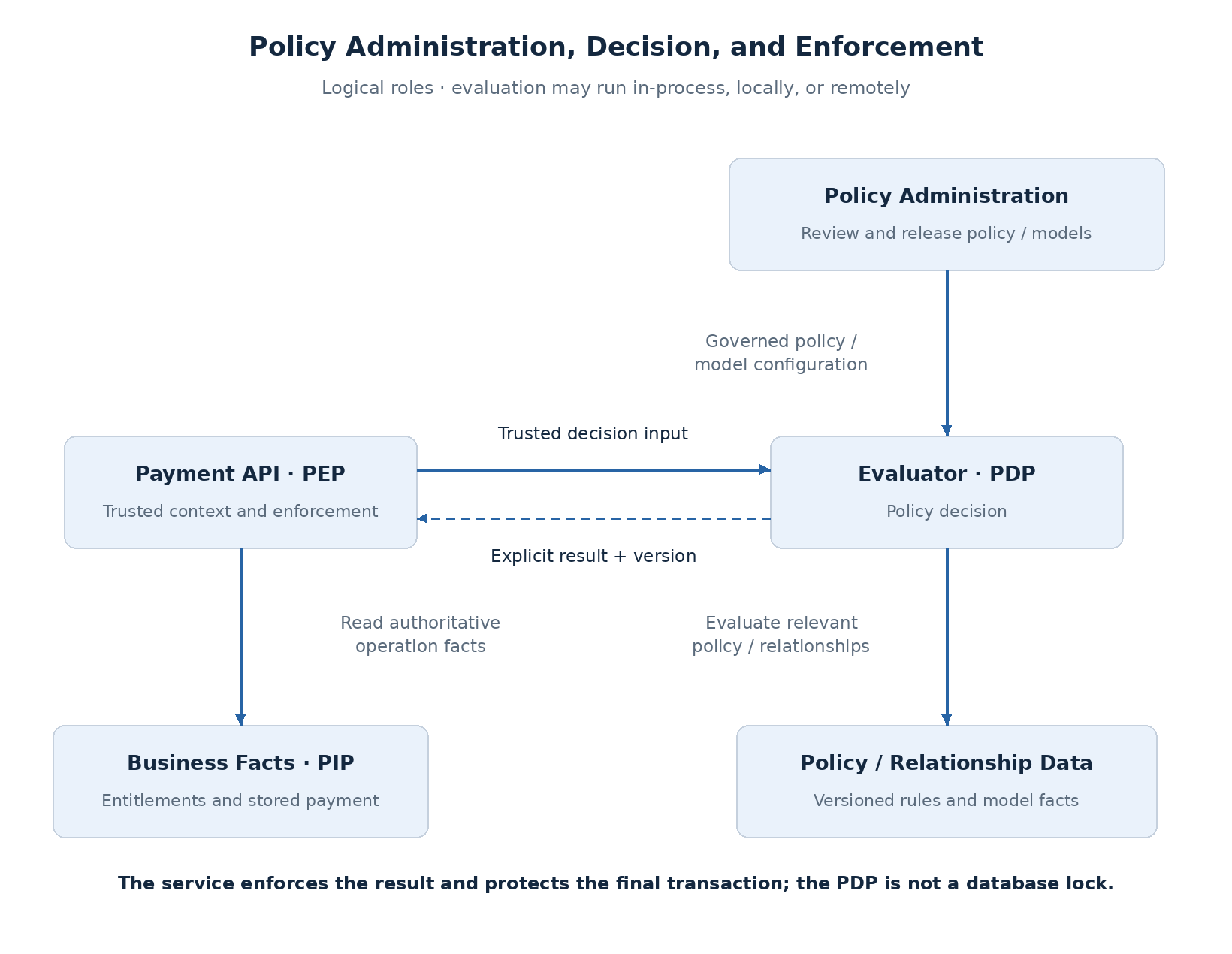
The API remains responsible for enforcement. An external allow result must not bypass resource-state checks, required conditions, or the final transaction boundary.
Compare deployment choices
| Design | Benefit | Cost / limitation |
|---|---|---|
| In-process evaluator | Low latency; direct access to service facts | Shared rule changes follow application/library releases |
| Local engine or sidecar | Low network latency; policy can evolve separately | Engine resources, rollout, readiness and policy freshness |
| Remote authorization service | Shared evaluation/model and independent lifecycle | Network and datastore dependencies; common failure domain |
A centrally governed policy can be evaluated locally. Central policy ownership does not require a remote call for every request. Conversely, a remote service does not guarantee consistent decisions if its inputs or caches are stale.
For a small claims service, a tested application evaluator is sufficient. Externalization becomes useful when shared policy, relationship complexity, or independent governance justifies the extra operating model.
OPA and OpenFGA solve different parts of the problem
| Engine | Main approach | Natural claims use |
|---|---|---|
| Open Policy Agent (OPA) | General-purpose policy evaluation over structured input and data | Approval rules involving amount, subject, action and context |
| OpenFGA | Authorization model plus relationship tuples and derived relations | Account/team/claim ownership and inherited resource rights |
OPA evaluates policy, commonly written in Rego. It does not automatically discover current business data: the application supplies input, or another governed integration makes data available to the engine. OPA can run locally or remotely. See OPA deployment guidance.
OpenFGA stores and queries a relationship model. Its checks answer whether a subject has a specified relation to an object, including derived access. Conditions can extend that model; it is not limited to unconditional graph membership. Its data updates, query consistency, and model lifecycle must be designed. See OpenFGA models.
Do not choose an engine from the label “fine-grained authorization” alone. Compare required rules, relationship queries, authorized-object listing, source-of-truth integration, and operating cost. Combining engines may be possible but adds coordination and decision-composition complexity; the claims baseline does not need both.
Define the decision contract
For an approval request, the PEP builds context from a validated identity and authoritative payment/entitlement data.
| Input | Trust requirement |
|---|---|
| Subject and calling client/actor | Derived from accepted credentials, not arbitrary headers |
| Action and resource | Determined by the protected operation and resolved resource |
| Amount, account, initiator, state/version | Persisted payment facts |
| Limits, permissions, relationships | Governed authorization data with known freshness |
| Assurance/environment | Verified source with defined meaning |
The PDP returns an explicit decision and sufficient safe metadata to trace its policy/model version. If a result includes conditions or obligations, the PEP must enforce them; it cannot reduce a conditional result to an unconditional Boolean.
Authenticate remote callers, authorize access to the appropriate policy/store, and protect service communication. A writable policy endpoint or caller-injected relationship can turn the authorization system into a privilege-escalation path.
Follow evaluation through commit
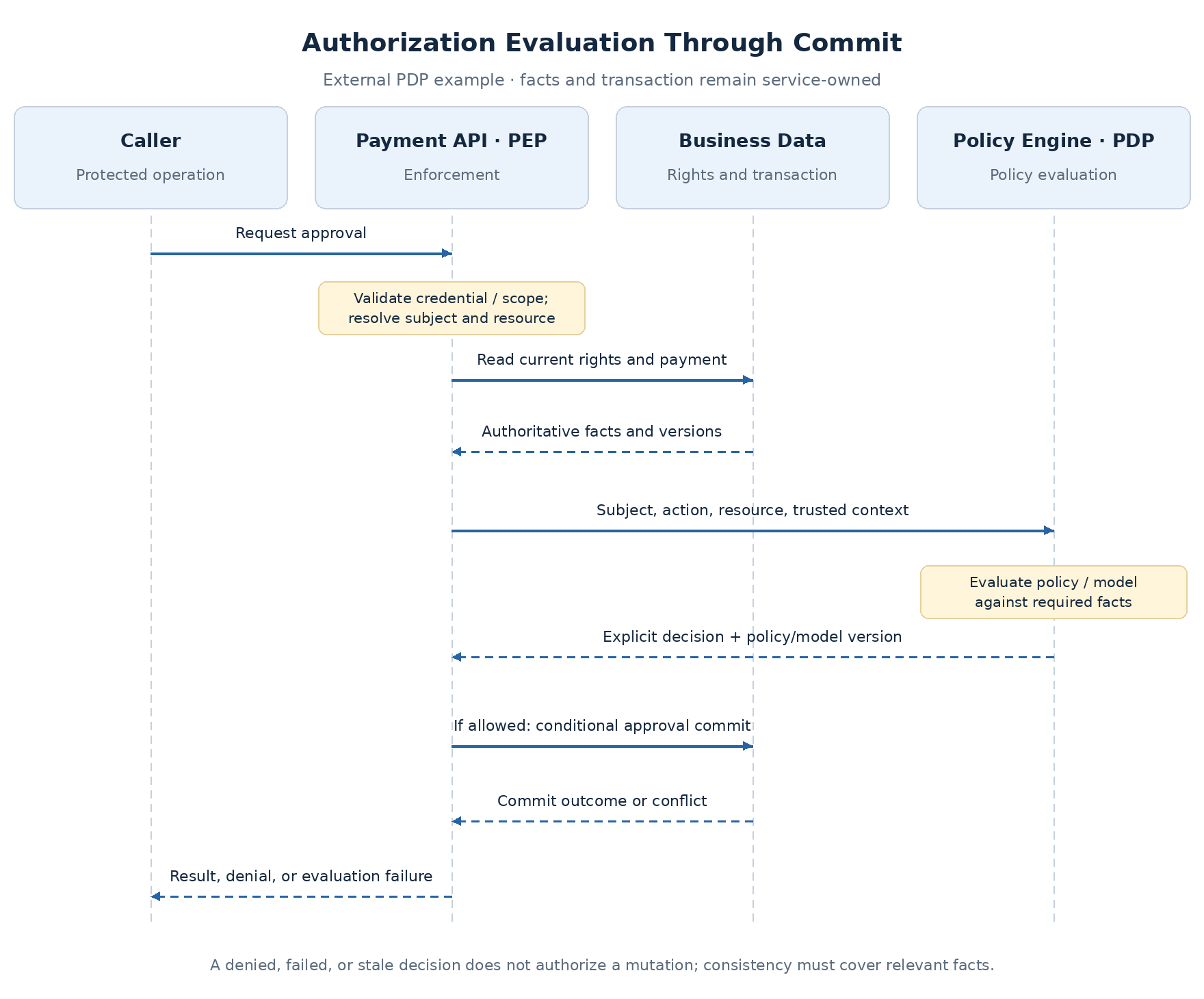
The API gathers trusted facts, obtains a decision, and commits only while its required conditions hold. A remote allow result is not a database lock. Payment state, version, or account rights can change between evaluation and use.
Define a transaction, lock/version protocol, or other consistency arrangement covering the facts required at commit. A payment-version check protects payment edits but not every entitlement change. Keep the service-owned invariant checks close to the mutation and define valid ordering for concurrent access removal.
Separate policy freshness from data freshness
- Policy/model: which rule version is active at each evaluator?
- Authorization facts: how current are entitlements and relationships?
- Decision cache: can a previous allow still be reused?
OPA bundles can distribute policies and data with eventual updates. A local evaluator may remain available during control-plane failure while using its last accepted bundle; define a maximum age and minimum required revision. A newly started engine without valid policy must not serve unchecked requests. See OPA bundles.
OpenFGA offers query consistency choices, including higher consistency that bypasses relevant caches. This does not make a relationship check atomic with the Payment API's database commit or update an upstream source that has not synchronized yet. See OpenFGA query consistency.
Cache keys need the subject, action, resource, policy/model context, and relevant data versions. Permission removal must have a defined invalidation or expiry path. Sensitive approval must not inherit a read-cache policy by convenience.
Failures and capacity
| Condition | Required behavior |
|---|---|
| PDP denies | Enforce denial |
| Timeout, malformed/undefined result, missing required facts | Do not treat as allow; return the appropriate evaluation failure |
| Local policy delivery interrupted | Use last accepted policy only within explicit freshness/readiness rules |
| Required engine unavailable | Sensitive action stops; no fallback to a broader rule |
| Old and new evaluators disagree during rollout | Identify versions; halt/rollback or use a controlled compatibility plan |
Remote evaluation adds latency and concurrent demand to every protected path. Size pools, timeouts, and engine/datastore capacity accordingly. Local engines trade remote hops for replicated CPU/memory and distribution work. Shared PDP or data stores need availability and isolation aligned with the services relying on them.
A single-object check and listing authorized resources have different cost profiles. Batch or authorization-aware query interfaces can reduce per-item calls, but must preserve visibility, pagination, and partial-result semantics. The modeling page defines those read boundaries.
Roll out and observe policy changes
Treat policy/model changes as releases: review, regression-test allowed and denied cases, record versions, stage changes, and define rollback. New models may require data migration as well as code changes.
Shadow evaluation can compare a proposed policy with the enforced one. Shadow results must not authorize traffic. Restrict rollout comparisons to compatible versions and trusted, privacy-controlled inputs.
Measure decision latency, error rates, denials by safe category, cache behavior, bundle/model revisions, and data-update delay. Correlate decision IDs with business audit outcomes. Decision logs can contain sensitive input; mask or omit unnecessary fields before retention or export, as described in OPA decision logs.
Proposed direction
Retain the application evaluator and authoritative entitlements for the initial claims milestone. ADR-004 remains proposed; external engine selection is deferred until requirements justify it.
Consider OPA for independently managed conditional rules and OpenFGA for a substantial relationship model. Validate their data and failure contracts before replacing in-process checks. Whichever deployment is selected, the Payment API owns enforcing the result and protecting the transaction.
Next: step-up authentication and authentication freshness—when valid identity and business permission are insufficient assurance for a sensitive operation.